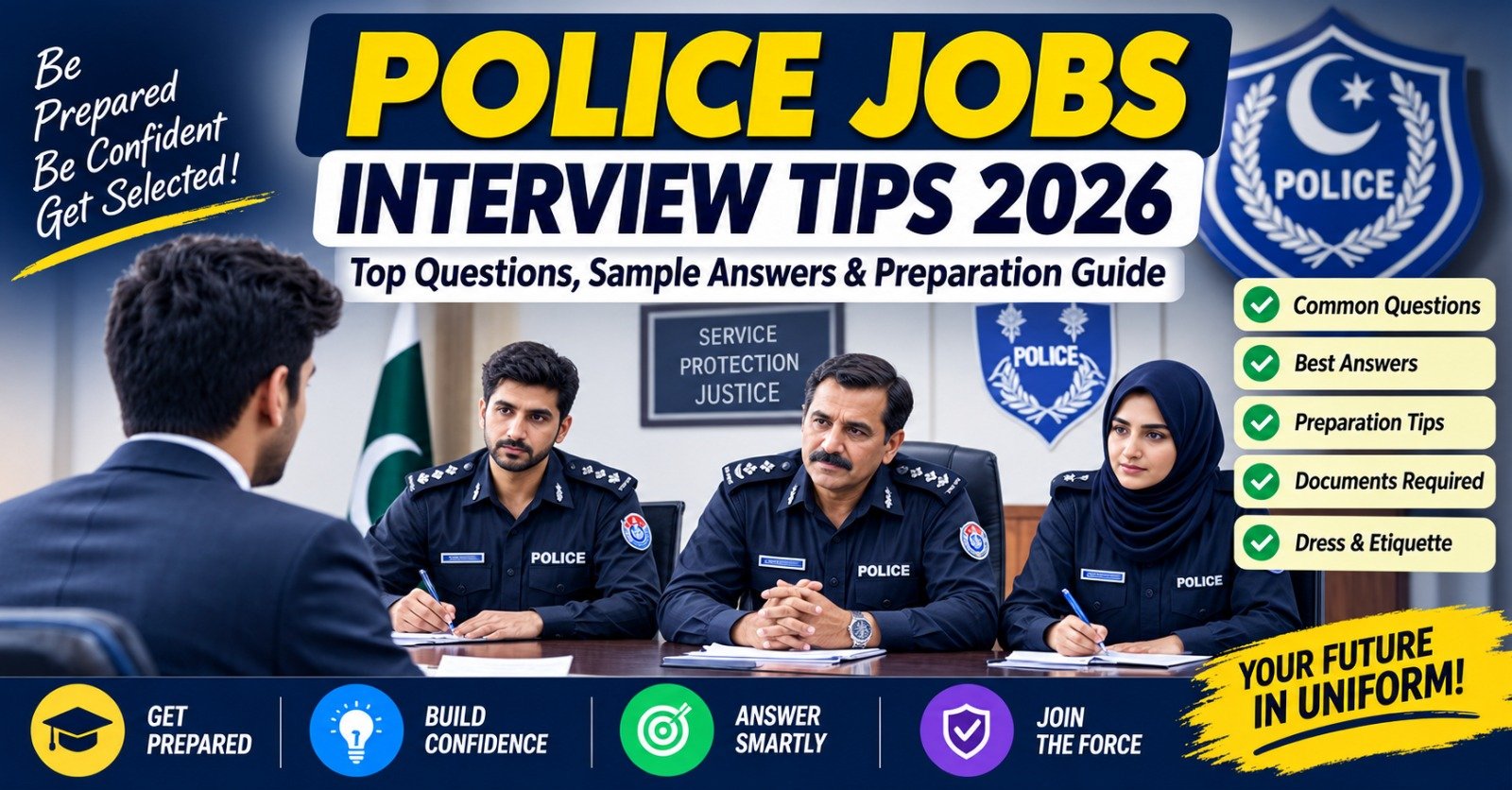
Introduction to Police Jobs Interview Tips
Getting as selected for a police job have requires more than submitting an application or passing a written examination. Candidates may also need to demonstrate the skills of a communication, discipline, honesty, ability of the decision-making, confidence and an understanding of the responsibilities that are associated with the enforcement of a law. The interview is an opportunity for a panel of the recruitment to assess that whether an applicant will understands the importance of a public service and can respond to the questions in a mature and responsible manner.
If you are preparing for an interview of police in the Pakistan, whether for a constable, Assistant Sub-Inspector (ASI), Sub-Inspector (SI) or another advertised position, your preparation should be based on the official notice of a recruitment and the requirements of the specific post. Different departments and campaigns of a recruitment may follow a different procedures of the selection, so candidates should never assume that every interview in police will follows an exactly the same format.
This guide will explains how to prepare for a interview of job in the police, how to answer a common questions, which documents to check, and how to avoid the mistakes that can weaken an otherwise good performance. It will also provides a sample answers that you can adapt to your own qualifications and experience. These examples are for a purposes of preparation, not the guaranteed questions or official answers from a board of recruitment. The most effective approach is to understand the meaning which is behind each of the question and practise in answering as honestly in your own words.
Memorising a long paragraphs without understanding them can make your responses to sound as unnatural. Instead, learn out the main points, use a relevant examples from your education or personal experience, and communicate as clearly. With a consistent preparation, accurate information and a professional attitude, you can enter your interview as better prepared to explain why you want to join the police and how you can approach the responsibilities of the position.
Why Is the Police Job Interview Important?
A interview in police may help the panel of recruitment to assess the qualities that cannot be fully measured through a written tests as alone. Depending on the rules of recruitment, the panel may consider your motivation, communication, general awareness, integrity, attitude towards the citizens and understanding of the advertised position. Police officers can encounter a difficult situations which is involving the public complaints, emergencies, conflict and a sensitive information.
For this reason, the questions in an interview may explore that how a candidate will thinks in under a pressure, follows the lawful instructions, respects the people and responds when faced with an ethical challenge. A strong candidate will not need to pretend that he know everything. It is generally better to acknowledge the limits of your knowledge and explain that how you would seek an accurate information than to confidently provide a false answer.
The interview is also an opportunity to show that you understand the policing as a public responsibility rather than simply a title of job, uniform or source of an employment. A professional candidate will recognises the importance of protecting a people, respecting the legal procedures, treating the citizens as fairly and maintaining a discipline. You should be prepared to explain your reasons for the applying, the skills which you can contribute and the areas in which you can hope to get improve. Your answers should reflect the responsibility and judgement of a sound as instead of an aggression or the unrealistic claims about an authority.
For an example, when you are discussing the safety of a public, explain the importance of preventing a harm, following the law, communicating as respectfully and requesting an appropriate assistance when it is necessary. Remember that a performance in the interview is only a one possible part of the broader process for a selection. Written examinations, physical assessments, medical requirements, verification of a document, criteria of an eligibility and the other stages may also apply as according to the official advertisement of a recruitment.
How to Prepare for a Police Job Interview
Research the Police Department and Job Position
Before attending your interview, you will need to read the official advertisement of a recruitment as carefully and identify the department, title of a post, requirements of an eligibility, procedure of the application and any instructions for a shortlisted candidates. Learn the basic responsibilities as associated with the position for which you have applied. A constable, ASI and Sub-Inspector may have a different responsibilities, authority and requirements of an entry, so your preparation should reflect the actual role rather than a general idea of the work of police. You should also understand that the public-service responsibilities of a department, with including the maintaining of a law and order, assisting the citizens, responding to an incidents and supporting the lawful investigations where these duties will fall within the role.
Use an official departmental websites and notices of government for a factual information. Avoid as relying on a posts on the social media that can make an unsupported claims about the criteria of a selection, questions in interview or a guaranteed appointments. If the notice of a recruitment will specifies a particular documents, times of reporting, locations or instructions, then follow those requirements rather than advice from an unofficial source.
Improve Your Communication Skills and Confidence
Good communication does not mean speaking as continuously or using the complicated English. It have means that understanding a question, organising your thoughts and delivering a clear, and a response which is relevant. Practise in answering a common questions of interview as aloud, either in front of a mirror or with a trusted person which is acting as the panel of interview. Keep your answers as focused on the question and support them with an examples when it is appropriate. If the panel will asks a question in the Urdu or another language you are comfortable with, then follow the instructions and answer as clearly as possible.
Do not assume that speaking the English as fluently is as mandatory unless the official process of a recruitment will specifies the requirement of a language. Work on your posture, skills of a listening, eye contact where it is culturally appropriate, and a respectful manner. If you do not understand a question, then politely ask the interviewer to repeat or clarify it as instead of guessing. Confidence will comes from a preparation and honesty, not from pretending to have the knowledge or experience which you do not possess.
Prepare Your Documents in Advance
Review the checklist of document in the official advertisement or notice of interview. Depending on the campaign of recruitment, applicants may be asked to bring a CNIC, educational certificates, details of application, a roll number slip, domicile, photographs or other specified records. These are examples, not a universal list of the documents that are mandatory. Check whether the originals, photocopies, attested copies or a particular number of a copies are required.
Organise the requested documents in a folder so that you can present them without a confusion. Make sure that your name, date of birth and other details are consistent in across your records, and do not alter or misrepresent any information. If you discover an error in a document, seek a guidance from the relevant issuing authority or office of recruitment as before the interview. Preparing these details in an advance can reduce the unnecessary stress and help you to concentrate on answering the questions of panel as professionally.
Top Police Interview Questions and Answers
The following interview questions for police and sample answers can help you to practise. Adapt each answer to your actual background, qualifications and a motivation. Do not claim an experience, training or achievements that you do not have.
1. Tell Me About Yourself
Sample answer: “My name is [Your Name], and I have completed my [Your Qualification]. I will consider myself as a responsible, disciplined and hardworking person. During my education and personal activities, I have tried to develop the communication, teamwork and problem-solving skills. I am interested in this position because I want to contribute to a public service and take on the responsibilities that will require the honesty, commitment and respect for the law. I understand that work of police can be demanding, and I am willing to learn, follow a lawful instructions and improve my professional skills.”
Preparation tip: Keep your introduction as brief and relevant. Mention your real qualification, useful skills and motivation for applying. Avoid as sharing an unnecessary personal details or reciting your entire biography. Practise until your introduction will sounds as natural rather than memorised.
2. Why Do You Want to Join the Police?
Sample answer: “I want to join the police because I am interested in a public service and would like to contribute to the safety and well-being of the community. I understand that the police work will involves a responsibility, discipline, teamwork and dealing with the people from a different backgrounds. I want to develop the skills that are needed to perform these duties as professionally while respecting the law and the rights of a citizens. I also understand that this career can involve the challenging situations, and I am prepared to learn and carry out my assigned responsibilities as conscientiously.”
Preparation tip: Explain your genuine motivation. Avoid as saying that you want the job as only for an authority, status or the uniform. If a personal experience have influenced your decision, you can briefly describe it as long as it is truthful and appropriate.
3. Why Should We Hire You for This Police Job?
Sample answer: “I believe that I can be a suitable candidate because I take the responsibility as seriously, respect the rules and am willing to learn. I understand that a employee of police must demonstrate an integrity, discipline, fairness and a professional attitude towards the public. I would make an effort to follow the lawful instructions, work as cooperatively with a colleagues and complete my duties as carefully. I also recognise that I will need a continued training and experience to perform as effectively, and I am prepared to accept the feedback and improve.”
Preparation tip: Connect your strengths to the requirements of the advertised position. If you have a relevant work of volunteer, teamwork experience, educational achievements or training, then mention a genuine example. Do not promise that you will never make a mistake; demonstrate that you understand accountability and learning.
4. What Are the Main Duties of a Police Officer?
Sample answer: “The duties of a police officer will depend on the assigned role and applicable law, but they can include helping to maintain the order in public, responding to a complaints and incidents, protecting the people, assisting in during an emergencies and carrying out a lawful duties as assigned by the authorised supervisors. Police personnel are also expected to behave as professionally, respect the citizens and follow the required procedures. I understand that the trust of a public is important and that powers of police must be exercised as responsibly and within the law.”
Preparation tip: Learn the duties that are relevant to your specific post and department. Avoid making an unsupported legal claims or assuming that every rank has an identical powers. If the panel will asks about a particular procedure, answer as according to your verified knowledge.
5. What Would You Do If Someone Offered You a Bribe?
Sample answer: “I would refuse the bribe and would not allow the personal benefit to influence my duties. I understand that integrity is essential in a public service and that accepting an improper payment can undermine the trust of public and may violate the law or departmental rules. I would follow the applicable procedure of reporting and inform the appropriate authority as it is required. I would also make sure that my actions will remained as professional and consistent with the relevant rules.”
Preparation tip: Emphasise as honesty, accountability and the proper process of reporting. Do not suggest that you would negotiate the amount, accept the money as temporarily or ignore a corruption as simply because the person who is making the offer is influential.
6. How Would You Deal with an Angry Citizen?
Sample answer: “I would remain as calm, listen as carefully and try to understand the complaint of person without responding as aggressively. I would communicate as respectfully, explain what assistance or procedure may be available and avoid making a promises that I cannot fulfil. If the situation became unsafe, I would follow the appropriate safety procedures and seek assistance when necessary. My objective would be to handle the matter as fairly, professionally and within the law.”
Preparation tip: Show a patience, emotional control and judgement of sound. Explain how you would de-escalate the tension while recognising that immediate safety may take a priority in the dangerous situation.
7. What Are Your Strengths and Weaknesses?
Sample answer: “My strengths will include as being responsible, willing to learn and able to work with the others. I will try to complete the assigned tasks as carefully and accept a constructive feedback. One area on which I am working to improve is [state a genuine weakness], and I am addressing it by [describe a practical step]. I believe recognising areas for improvement is important because professional responsibilities require continuous learning.”
Preparation tip: Select a real weakness that you can discuss as constructively. Avoid as pretending to have no weaknesses or choosing a weakness that will suggests a disregard for the honesty, safety or responsibility. Be prepared to explain what you are doing to improve.
8. What Would You Do If You Received an Instruction You Believed Was Unlawful?
Sample answer: “I would take the matter as seriously, remain as professional and seek a clarification through the appropriate chain of a command or procedure of reporting. I understand the importance of a discipline, but I also recognise that the duties must be performed within the law and applicable rules. I would not knowingly take an unlawful action as merely because I felt as pressured. I would follow the relevant procedure to address the concern and seek guidance from an authorised source.”
Preparation tip: Demonstrate that you have understand both the discipline and accountability. Do not imply that every instruction should be followed as blindly or that a personal disagreement as alone will makes an instruction unlawful.
Police Interview Preparation in Pakistan
Police recruitment in the Pakistan is conducted through the relevant department or authority, and the process can vary by a province, rank and campaign of a recruitment. Candidates should first identify the department which is named in the advertisement and then consult its official website or the recruitment notice of a government for the requirements which are applicable. Information about the Punjab Police, Sindh Police, Khyber Pakhtunkhwa Police, Islamabad Police and Balochistan Police should not be treated as an interchangeable.
Age limits, education, domicile, physical standards, deadlines of an application, stages of a selection and the required documents may differ. Similarly, a campaign of the recruitment may use the written examinations, physical tests, interviews, scrutiny of a document or other assessments that are according to its rules. Do not rely on a general article as a confirmation that you are eligible for this particular vacancy. Verify the exact title of post, reference of application, reporting the instructions and deadlines as before making an arrangements of travel or paying any authorised fee. Be cautious of an unofficial individuals who have claim they can guarantee a selection in the return for money or personal information.
Punjab, Sindh, KP, Islamabad and Balochistan Police
If you are applying for a provincial police department, review the official advertisement of a recruitment and any instructions as published by the relevant authority. Candidates who are applying in the Punjab should verify the current notice of a Punjab Police; those who are applying in the Sindh should check the applicable information of a recruitment in the Sindh Police. Applicants in the Khyber Pakhtunkhwa, Islamabad or Balochistan should likewise use the official information for the relevant department and post. Prepare a general topics of the interview such as your motivation, responsibilities of an advertised role, integrity, public service, communication and the situational judgement.
Where the official notice or syllabus will identifies the specific areas of a knowledge, give those topics a priority. Do not assume that a candidate who is applying for one province can use every detail of an eligibility or rule of a selection which is published for another province. Before attending the interview, confirm the venue, date, time, documents that are required and any instructions which is concerning a dress or reporting. If a notice will appears as unclear or conflicting, then contact the relevant office of a recruitment through its official channel of the contact.
Police Constable, ASI and Sub-Inspector Interview Tips
Candidates who are applying for the positions of a constable, Assistant Sub-Inspector or Sub-Inspector should tailor their preparation to the responsibilities and requirements for an entry in the actual post. For an interview of the constable, practise in explaining a discipline, teamwork, interaction with the public, willingness to learn and the importance of following a lawful instructions. For a recruitment in the ASI or Sub-Inspector, the relevant role may require a preparation for the questions about a responsibilities of the supervisory, communication, making of decision or procedures that are identified in the official material of a recruitment. These are preparation that will suggestions, not a guarantee that a panel will ask a particular questions.
Review the description of a job and learn the limits of the position rather than assuming that the rank alone will gives an unlimited authority. In every case, candidates should demonstrate an integrity, respect for the citizens and an understanding that work in a police will requires the professional conduct. If you have a previous work, educational or experience of volunteer that will demonstrates the responsibility, then prepare a short example to explain what you did, how you handled a challenge and what you have learned from it. If you are a fresh candidate, use a genuine examples from your education, teamwork or activities of a community as instead of inventing the experience of an employment.
Documents to Bring to a Police Job Interview
Document preparation is an important part of the readiness of an interview because missing the paperwork or inconsistent information may create an avoidable difficulties. Start with the official notice of an interview, which should be your main reference for what you will need to bring. Depending on the campaign of a recruitment, the required records may include a CNIC, educational certificates, transcripts, domicile, form of an application, slip of roll number, photographs or other specified documents. Not every process of a recruitment will requires the every item on this list, so do not assume that a generic checklist will replaces the official instructions.
If the notice will asks for an originals and photocopies, organise them as separately and check the required number of a copies. Ensure that your name and other details are consistent in across the records which you have submit. Never submit the forged documents, change your qualifications or conceal the information that the application will requires. If a certificate is pending or a record have contains an error, then seek for a clarification from the appropriate authority as before the interview rather than making an unsupported claim. Prepare your folder the day as before and keep the notice of an interview as accessible so that you can confirm the address of a reporting, time and any additional requirements.
What to Wear to a Police Interview
Choose a clean, neat and appropriate clothing that will follows any specific instructions in the notice of a recruitment. If no requirement of a uniform or special dress is mentioned, then a professional and modest attire is generally a sensible choice. Make sure that your clothes are comfortable, well presented and suitable for the setting. Personal grooming should be tidy, and accessories should not distract from your answers. More importantly, dress should support rather than to replace a preparation. Arrive with an enough time to locate the venue of an interview, complete any required check-in and settle yourself as before your turn.
During the interview, greet the panel as respectfully, listen to the complete question and answer without interrupting. Maintain a composed posture and make a natural eye contact, where it is appropriate. You do not need to force a smile or use an exaggerated gestures. If you feel as nervous, then pause as briefly, breathe as calmly and organise your thoughts as before answering. Nervousness is normal, particularly for the candidates whose its first-time, and a measured response is often better than a rushed one. Treat every member of the staff of a recruitment as courteously, follow the rules of a venue and keep your phone as silent or switched off as it is instructed.
Common Police Interview Mistakes to Avoid
One common mistake is memorising the word for word of a sample answers and then struggling when the panel will asks a follow-up question. Sample answers should teach you how to structure your response, and not replace your own judgement. Another mistake is providing a false information about the qualifications, previous experience, connections in the family or achievements. Such a claims can damage your credibility and may create a serious consequences of the recruitment. Candidates should also avoid as arguing with the interviewers, interrupting the questions, speaking as disrespectfully about the citizens or presenting a force as the answer to every problem.
Effective policing will requires a lawful action, appropriate communication and judgement of sound. A further mistake is ignoring the official notice of recruitment and relying as exclusively on a social media posts or unofficial guides of interview. This can result in a preparation for the wrong post, and misunderstanding of an eligibility or missing a document.
Finally, do not assume that a result of an interview can be secured through a payment, personal connection or a guaranteed-selection offer. Follow the official channels of a recruitment and report a suspicious requests through the appropriate authority. Focus on what you can control: an accurate information, preparation, punctuality, honesty and a professional conduct.
Practical Tips to Perform Well in a Police Interview
A useful way to prepare is to create a simple schedule of practice several days as before the interview. Begin by reviewing your application and the official notice of a recruitment. Next, practise your introduction, motivation for joining the police and understanding of the position. Then work through a situational questions about the honesty, complaints of a public, teamwork, response in the emergency and a professional responsibility. Ask a friend or member of family to conduct a mock interview, or record your answers and review that whether they are clear, relevant and concise. Do not focus as exclusively on a general knowledge if the notice of a recruitment will identifies an other important areas.
Prepare the examples that will demonstrate a responsibility, patience, solving of problem and the ability to learn from a mistakes. On the day as before the interview, confirm the venue and time of a reporting, organise your documents and plan your journey. Get an adequate rest and avoid a memorisation on last-minute of the large amounts of an information.
During the interview, listen as carefully, answer the question which is asked and request for a clarification when it is necessary. If you do not know an answer, remain as composed and be honest as instead of guessing as confidently. The aim is to show that you can think responsibly, communicate as respectfully and take the duties of the advertised position as seriously.
Also Read: Interview Tips for Army PMA Selection 2026 – Important Questions, Best Answers & Preparation Guide
Frequently Asked Questions About Police Job Interviews
How Can I Pass the Interview of a Police Job?
Prepare by reviewing the official advertisement of a job, understanding the role, practising a common questions of an interview and organising all the required documents. Communicate as clearly, remain as respectful and give a honest answers. Remember that the performance in an interview does not guarantee a selection because the authority of a recruitment may consider the other requirements of an eligibility and stages of an assessment.
What Questions Are Asked in an Interview of the Police?
Questions may concern your introduction, education, motivation for joining the police, strengths, weaknesses, responsibilities of a job, integrity, teamwork and responses to the situations that are challenging. The actual questions will depend on the department, post and process of a recruitment. Use a sample questions as practice rather than assuming that they are an official or complete list.
How Should I Introduce Myself in an Interview of Police?
Begin with your name and relevant educational qualification. Briefly explain a two or three genuine strengths and why you are interested in the position. Keep your introduction as organized and professional. Avoid an unnecessary personal information, exaggerated claims or a long speech that does not relate to the job.
Is General Knowledge Important for an Interview in the Police?
General knowledge may be relevant, as depending on the process of a recruitment and advertised position. Review the official syllabus or instructions where it is available, and prepare a relevant information about the Pakistan, public service and the department. Prioritise a verified facts as instead of relying on an unconfirmed lists of the question that are circulated as online.
What Documents Are Required for an Interview of Police in Pakistan?
Requirements vary by the department and campaign of a recruitment. The official notice may specify an identification, educational records, domicile, details of an application, photographs or other documents. Check the precise list and instructions for an originals, photocopies and attestation as before attending.
Can I Prepare for an Interview of Police at Home?
Yes. You can practise in speaking as aloud, conduct the mock interviews, review your application, research the advertised position and prepare your documents at a home. Ask someone to give you an unexpected follow-up questions so that you can learn to explain the ideas in your own words rather than simply memorising the answers.
Conclusion: Final Police Interview Preparation Advice
Preparing for a interview of the job in the police will requires the planning, self-awareness and a clear understanding of the responsibilities that are involved in a public service. Candidates should begin with the official advertisement of a recruitment, verify the requirements for their specific post and practise the answers that will reflect their genuine qualifications and experience. Questions about the motivation, integrity, discipline, communication and situational judgement will provide a useful opportunities to demonstrate the maturity and professional responsibility.
A well-prepared candidate should also organise the documents, choose an appropriate attire, arrive on a time and remain as calm when answering the difficult questions. Remember that there is no universal set of the questions that will guarantees a success, and no guide can promise a selection. Recruitment procedures can differ in between the departments and vacancies, so an official instructions must always take a priority over the general advice. Focus on developing a clear communication, honest answers, respectful behaviour and judgement of a sound.
Whether you are applying for a constable, ASI, Sub-Inspector or another position of the police, consistent preparation can help you to approach the interview with a greater confidence. Treat the interview as an opportunity to demonstrate your suitability for a public service and your willingness to learn, follow the law and carry out your responsibilities as professionally.
Also Read: https://prepbeepakistan.com/interview-preparation-guide-for-all-govt-jobs
1 thought on “Police Jobs Interview Tips 2026 – Top Questions, Sample Answers & Preparation Guide”